
Reflect on the semester's readings, discussions, assignments, etc. Has your vision changed? What are you looking forward to implementing in your school library program? What worries you about the profession? What are the challenges?
It has been so interesting to take this course at the same time as I began work as a school librarian. Already I can see both ways that topics raised in our course apply to the real world of librarianship, as well as obstacles that come up when theory starts to get put into practice.
A theme that I've considered often over the course of this semester is the dynamic nature of librarianship. This seems like a profession that is continuously changing and evolving, or at least has the potential to. I know from my years as a classroom teacher that routines are necessary in schools, but that it's easy for a routine to become a rut. I'm wondering about how I will stay on top of developments and new ideas in the field, once I'm out of library school. I also wonder about collaboration. It's been great to have classes full of colleagues and professors who are all interested in school librarianship, who are available for brainstorming with and bouncing questions around. How will the nature of collegiality change if I'm the only librarian at a school? What are some other avenues for collaboration and professional affinity?
My worries:
-finding a (full-time) job at all
-budget woes
-getting to know a collection well enough to be able to match books with all sorts of readers (how do librarians do this? it seems like magic to me)
-getting to know hundreds of students instead of one class at a time, and wondering if relationships with so many kids at once will be as fulfilling as those were with my first grade students
Budget and job searching issues notwithstanding, I think that my other worries will be resolved just by having more time and experience actually working as a librarian, and bridging that theory-practice divide. I appreciate that many of our assignments have focused on practical tools that could be used in a real life library setting (particularly the tech tools).
Overall, I feel hopeful about the potential for school libraries and excited (if sometimes intimidated) about getting further into the profession. I think it's important work. I hope I'm up to the task.
Saturday, December 4, 2010

Saturday, November 13, 2010
school libraries and advocacy
What is the role of advocacy in the school library? To whom should you apply advocacy efforts, why? In investigating advocacy efforts what do you see that you like? What concerns do you have? What challenges are facing school libraries?
There always seems to come a point in classes where I hit the theory-vs.-practice wall. That is to say, I read or hear or learn things in my courses that sound good in theory, but I’m not quite sure how I will implement them in my practice as a school librarian. Advocacy is somewhat like that for me. I think advocating for the importance of school libraries (and library funding, programming, resources, etc.) is tremendously important, and an undeniable necessity in this profession right now. But it’s hard to know what it looks like in practice—or how to find the time to do it.
Given all of that, I really appreciate the depth of the resources at the AASL website— to know that there are ready-made, readily available sources of information and advocacy ideas is so helpful. All of the advocacy toolkits are resources I can definitely imagine using and revisiting over and over again. They really help distill a big concept like advocacy into manageable, easy to understand ideas and suggestions for action.
While I’m not totally sure how advocacy efforts fit into the day to day workings of a school library, I do feel like those efforts should be an integrated piece of any school library program, as opposed to an afterthought added in only occasionally. I work in a school library right now which is exceptional in several ways—it is well-funded, with three library staff members (for a 500 student school); there is money for new books and author visits and professional development, and a good deal of collaboration with classroom teachers. At first glance, an outside observer might argue that there’s relatively little need for library advocacy. But I see the ways it is a part of the head librarian’s thinking all the time. Whether it’s creating a parent volunteer program, holding community events in the library, or thinking of ways to partner with other local schools with fewer library resrouces, there is a consistent, subtle way that she is promoting the library all the time. The goal is for the library to feel like (and be) an essential part of the school community, and for the community members to feel connected to the library. This work is ongoing.
Certainly contemporary libraries are challenged by budget constraints, first and foremost, and advocacy is necessary on all levels. From library promotion efforts in individual schools, to events like the ALA’s annual Library Advocacy Day, getting the message out that libraries are essential to learning is critical. We need to be able to explain why our efforts and programs are important to all kinds of stakeholders—students, parents, administrators, school boards, etc. Fortunately, there seem to be lots of resources out there to help librarians navigate the terrain of advocacy, and put theory into practice.
Saturday, October 30, 2010
shhh... don't tell the ala
Discuss the issues surrounding intellectual freedom, censorship, selection, and in loo parentis in school libraries. Do not restrict your comments to print format only, and consider how long standing programs (such as AR, or highly restrictive filtering) may play a role in intellectual freedom issues. How will you deal with these issues?
I love the ALA. I love that they’re fighting the good fight on important issues, and I am proud to be a card-carrying member of what I think is an important organization. I think that, theoretically, the ALA’s position statements on intellectual freedom are reasonable and aspirational and certainly well thought out. But to me, these statements deal too much in the realm of theory and don’t provide a lot of guidance to librarians in practice (which is fine-- this is just to say that they feel incomplete to me). It also seems, though I don’t know, that the ALA’s position statements apply more easily to public libraries, and that school libraries might face issues of intellectual freedom and censorship in different ways.
The ALA’s statement on Access for Children and Young Adults to Nonprint Materials states: “Recognizing that librarians cannot act in loco parentis, ALA acknowledges and supports the exercise by parents of their responsibility to guide their own children's reading and viewing” (www.ala.org, 2010). I understand that public librarians don’t (and needn’t) act in loco parentis, but I think that statement gets a lot blurrier in a school setting. Teachers do act in loco parentis in all sorts of ways.
Here is my question about nonprint materials: would the ALA condone unrestricted internet access in school libraries? I agree with the ALA’s statement that students should have unfettered access to “a diversity of content and format.” Surely, though, there is information that is so obscene or age-inappropriate that exposing children to it could be harmful to them. School libraries have collection development policies-- books that are appropriate for students are chosen by librarians. Not every book that is published is one that students have access to in school. I believe it should be the same for nonprint resources like the internet. I don’t think children should have unsupervised, unfettered access to the internet. I don’t know much about how filtering software works, but I feel that some level of guidance toward appropriate resources is necessary in school libraries.
As for labeling and rating systems, this is another area where the gap between theory and practice leaves something to be desired. I understand the ALA’s position that adding ratings or other labels to materials that aren’t part of the published product (ratings on movies or video games, for example) is a form of censorship, as it can either implicitly or explicitly limit a student’s access to library materials. However. I believe there are times where some guidance is appropriate and necessary. I think it’s important to consider the intent of the ratings, and the impact that they have. Are ratings there to provide guidance or to deliberately restrict access? It reminds me of the early 1990’s debate over warning labels on music, and the sale of certain music requiring parental consent. Here’s how I feel: warning label= okay; requiring parental consent= not okay. That’s essentially how I feel here.
The other question that comes up for me is, who is doing the labeling? When big bad Accelerated Reader adds ratings for its books, that makes me suspicious (though again, I don’t have a huge problem with it unless books rated MG+ aren’t made available to students who want to read them). If librarians create systems that work for their libraries and their communities, I have less of a problem with that. I realize that puts a lot of power in the hands of librarians, but I think we’re a pretty trustworthy bunch.
An example from the real world. I work in a K-8 private school library. The head librarian is a big proponent of YA literature, and has worked hard to create a teen section that will appeal to middle school readers. Books in the teen section that have particularly mature content or language have a red dot on the barcode-- 7th and 8th graders may check these books out freely, though K-6th grade students need parental permission to do so. I think the ALA would be super cranky about this. To me, it makes practical sense. A book for an 8th grader might really not be appropriate for a 2nd grader. Are the 2nd graders prohibited from browsing through the teen books? No. If a second grader wanted to borrow Twilight (or Breaking Dawn, for that matter), do I think a parent might want to weigh in? Yes. Could I find that second grader a really exciting book about love and vampires that was more age appropriate in the meantime? Sure. If the parent gave their consent, would I have a problem with a 2nd grader checking the book out? Nope.
Could guidelines such as the red dot system be misused and infringe on students’ intellectual freedom? Absolutely, but not necessarily. The head librarian at my school explained to me that this system has freed her up to develop a really rich and varied teen collection, without fretting too much about potentially mature themes or language. So it’s complicated.
No matter what a school library’s policies are regarding intellectual freedom and access to information, they should be clearly communicated to families, through collection development policies, letters home, or other means of family education. And we should of course continually be teaching students how to evaluate books and nonprint materials for themselves.
I love the ALA. I love that they’re fighting the good fight on important issues, and I am proud to be a card-carrying member of what I think is an important organization. I think that, theoretically, the ALA’s position statements on intellectual freedom are reasonable and aspirational and certainly well thought out. But to me, these statements deal too much in the realm of theory and don’t provide a lot of guidance to librarians in practice (which is fine-- this is just to say that they feel incomplete to me). It also seems, though I don’t know, that the ALA’s position statements apply more easily to public libraries, and that school libraries might face issues of intellectual freedom and censorship in different ways.
The ALA’s statement on Access for Children and Young Adults to Nonprint Materials states: “Recognizing that librarians cannot act in loco parentis, ALA acknowledges and supports the exercise by parents of their responsibility to guide their own children's reading and viewing” (www.ala.org, 2010). I understand that public librarians don’t (and needn’t) act in loco parentis, but I think that statement gets a lot blurrier in a school setting. Teachers do act in loco parentis in all sorts of ways.
Here is my question about nonprint materials: would the ALA condone unrestricted internet access in school libraries? I agree with the ALA’s statement that students should have unfettered access to “a diversity of content and format.” Surely, though, there is information that is so obscene or age-inappropriate that exposing children to it could be harmful to them. School libraries have collection development policies-- books that are appropriate for students are chosen by librarians. Not every book that is published is one that students have access to in school. I believe it should be the same for nonprint resources like the internet. I don’t think children should have unsupervised, unfettered access to the internet. I don’t know much about how filtering software works, but I feel that some level of guidance toward appropriate resources is necessary in school libraries.
As for labeling and rating systems, this is another area where the gap between theory and practice leaves something to be desired. I understand the ALA’s position that adding ratings or other labels to materials that aren’t part of the published product (ratings on movies or video games, for example) is a form of censorship, as it can either implicitly or explicitly limit a student’s access to library materials. However. I believe there are times where some guidance is appropriate and necessary. I think it’s important to consider the intent of the ratings, and the impact that they have. Are ratings there to provide guidance or to deliberately restrict access? It reminds me of the early 1990’s debate over warning labels on music, and the sale of certain music requiring parental consent. Here’s how I feel: warning label= okay; requiring parental consent= not okay. That’s essentially how I feel here.
The other question that comes up for me is, who is doing the labeling? When big bad Accelerated Reader adds ratings for its books, that makes me suspicious (though again, I don’t have a huge problem with it unless books rated MG+ aren’t made available to students who want to read them). If librarians create systems that work for their libraries and their communities, I have less of a problem with that. I realize that puts a lot of power in the hands of librarians, but I think we’re a pretty trustworthy bunch.
An example from the real world. I work in a K-8 private school library. The head librarian is a big proponent of YA literature, and has worked hard to create a teen section that will appeal to middle school readers. Books in the teen section that have particularly mature content or language have a red dot on the barcode-- 7th and 8th graders may check these books out freely, though K-6th grade students need parental permission to do so. I think the ALA would be super cranky about this. To me, it makes practical sense. A book for an 8th grader might really not be appropriate for a 2nd grader. Are the 2nd graders prohibited from browsing through the teen books? No. If a second grader wanted to borrow Twilight (or Breaking Dawn, for that matter), do I think a parent might want to weigh in? Yes. Could I find that second grader a really exciting book about love and vampires that was more age appropriate in the meantime? Sure. If the parent gave their consent, would I have a problem with a 2nd grader checking the book out? Nope.
Could guidelines such as the red dot system be misused and infringe on students’ intellectual freedom? Absolutely, but not necessarily. The head librarian at my school explained to me that this system has freed her up to develop a really rich and varied teen collection, without fretting too much about potentially mature themes or language. So it’s complicated.
No matter what a school library’s policies are regarding intellectual freedom and access to information, they should be clearly communicated to families, through collection development policies, letters home, or other means of family education. And we should of course continually be teaching students how to evaluate books and nonprint materials for themselves.
Wednesday, October 20, 2010
reflective journal: what's in a name?
 What is in a name? Over the last 25 years (probably longer) the title of school librarian has morphed from school librarian to media specialist to teacher librarian. In Canada and California, and maybe other places we are officially teacher librarians. According to AASL we are school librarians. You would be amazed (or at least I am) at the debate and passion this issue incurs. A recent webinar explored the issue, right after AASL's announcement - yes, we are school librarians. What is your take? Does the name matter? Why? Which would you choose? Why?
 I have a lot of thoughts about this seemingly innocuous question. Or two questions, really: What do we call ourselves? And, does it matter? I had to go with bullet points here, because my thoughts on this are flying in many different directions.
- It strikes me that this conversation, both the tone of the AASL discussion and the topic itself, reflects a profession that is somewhat in crisis, or at least in flux. If everything is hunky dory and things are going well, then you need to don’t devote a year of time to decide what to call yourself. The thrust of the AASL conversation was about branding and identity to the larger community, but I also feel that part of this question stems from the evolving self-identity of librarians, as well as the pressure of needing to continuously justify the importance of our work. So my first question is, who are we trying to define ourselves for? The public? Ourselves? Both?
- There was a lot of talk in the AASL webinar about the shift from an emphasis on information to an emphasis on knowledge. I like this. It reflects the shift in the research from a focus on “information literacy” to “guided inquiry." I think we’ve talked about this in class, too—the idea that information is the means, not the end. In some ways, I think this shift is about an acclimation to an information-saturated world. Perhaps 20 years ago the conversation was about, “Hey wow, look at all of this information!” And now it’s a given that the information is there, and the focus is on what we do with it.
- The move toward (or back to) school librarian as the “official” title for our profession is a way of re-encompassing what librarians do and are responsible for. I don’t know the whole history, but I can imagine that job titles like Library Media Teacher/Specialist and Information Technology High Priestess emerged due to changes in the profession and in school libraries. If librarians weren’t only reading books and helping with print reference anymore, but were doing more media and technology-related work, then perhaps some felt that a new title was needed to reflect these changes. Now I feel like there’s a move to bring it back and say, yes, libraries are changing and librarians are in charge of all of this— books and tech and computers and kindles and reference and databases and all of it— to sort of bring it all back in under the umbrella of librarianship. I appreciate that—it strikes me as a more integrative step than fracturing the job title. It’s post-postmodern!
- That said, I kind of think people should get to call themselves what they want, as a general rule, though I suppose professional associations get to be a little bit fascist about it, if they want to be. It was interesting for me to read some of the comments on the ALA and AASL websites about this issue—some school librarians clearly felt strongly about their professional identity and job title. So yes, names do matter. And I think there’s room for variation, too. I think what’s ultimately most important is that our role is clear to our students, teachers and families that we serve. “School librarian” is simple, direct, and to the point. I must say, I also like teacher-librarian. But maybe the “teacher” should be implied? Like all librarians are teachers?
- I identify myself a school librarian, so I am happy to accept this AASL guideline. I think it’s an appropriate name. It’s easily understood, and it’s broad enough to encompass the many facets of contemporary librarianship.
Saturday, October 2, 2010
mission statements
School libraries are in a state of flux. As student needs change, and as technology becomes more central to our lives, and as libraries become “media centers,” we need to have an expanded definition of “literacy.” To me, literacy is at the goal of any school library’s mission. I feel that this sentiment is reflected in the AASL’s Common Beliefs, which celebrate reading and learning in many forms.
I feel as though some of the nine common beliefs could almost be mission statements by themselves. In terms of considering them through the lens of the mission statement, I think the most relevant and important beliefs are “School libraries are essential to the development of learning skills” and “The definition of information literacy has become more complex as resources and technologies have changed.” Both of these statements frame school libraries as central to learning, critical thinking, and skill building for 21st century learners. Some of the other beliefs are important, but perhaps not at the core of what school libraries are about. For example, I agree that “Ethical behavior in the use of information must be taught.” But this isn’t quite big enough an idea for a mission statement, in my opinion.
If I was going to write a school library mission statement, I think the most important ideas to include would be:
- The goal of literacy in multiple forms (information literacy, media literacy) along with comfort and engagement with the printed word
- The goal of helping students critically evaluate information (from encyclopedias to databases to tweets), to better prepare them to engage with the world around them
- Promoting inquiry, curiosity, and self-directed exploration
- Integration of technology into teaching and learning in the library
- The library as a site where community members (students, teachers, parents, administrators, etc.) can come together to interact, collaborate, and learn.
Even as I’m looking at this list, I feel like maybe that’s too much for a mission statement. There’s a lot that I believe libraries can be, so it’s hard to whittle it down to just a few meaningful sentences.
I’m reminded of Joshua Prince-Ramus’s fabulous TED talk about designing the Seattle Public Library building. He presented a diagram that showed the evolution of the public library—how public libraries began with a narrower focus that has expanded over time.
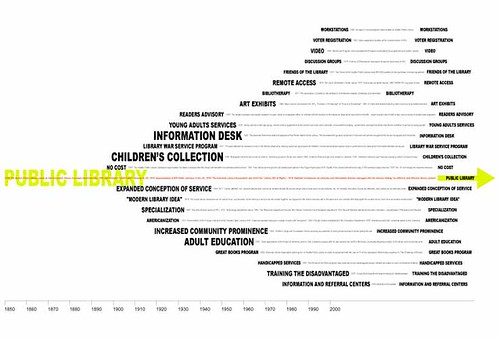
Though he’s talking about public libraries, I feel like this evolution is echoed in the role of school libraries, due if nothing else to the expansion of information in our culture. That libraries can be many things to many people is part of their magic, and yet it’s important to have a clearly defined mission and message.
So I’m not sure if my reactions to the Common Beliefs have changed- I still think they’re pretty fabulous and definitely relevant. Some strike me as more “mission statement worthy” than others, but they are a reminder that defining our goals and beliefs is an important step in achieving them.
Saturday, September 18, 2010
reflective journal: the aasl's 9 common beliefs
Read the 9 Common Beliefs (AASL_Learning_Standards_2007.pdf). Do you agree with them? What concerns you? excites you? is interesting? What questions do you have? How do they relate to current educational paradigms, philosophies, and/or policies?
God bless the AASL. Here’s to the researchers, educators, and librarians who thoughtfully codified these nine beliefs and learning standards. (Incidentally, I’m curious to compare the AASL library standards with those adopted by the California Department of Education this week, to see where they overlap and where they don’t.)
So, yes. The short version is: I’m on board with these common beliefs.
Here’s the longer version:
The AASL’s Common Beliefs strike me as a very pragmatic, thoughtful, forward-thinking collection of tenets that would serve as a useful guide for school library professionals, particularly pre-service librarians. I started my first school library job last week and I am thrilled to have a guide like this as I begin my first foray into this profession.
I like that these beliefs address specific and important components of the LIS realm, but are broad enough to be applied in a variety of contexts. I’m amazed and baffled that while educators across disciplines echo the sentiments of these beliefs and consider them among best practices, our educational system is so focused on discrete skills, standards, and testing, testing, testing. Who’s got time for inquiry? Sheesh.
I was struck by the inclusion of “texts in all formats” in the first belief, Reading is a window to the world. Raising pictures and video to the level of print is appropriate, I think, but potentially controversial. I appreciated also the assertion that reading includes decoding and comprehension of texts, but extends into critical thinking skills too. I like the focus on creating independent learners. It seems to me that a main theme of this document is that today’s students must learn how to reliably and critically evaluate information for themselves. Cultivating an attitude of inquiry and curiosity aids in the development of information literacy, especially when coupled with the technical and technological skills to support that curiosity. The emphasis on equity is an important one, as is the call for teaching ethical behavior. That learning has a social context isn’t a new idea in the world of education, but it was interesting to see this belief reconceptualized and applied to the digital world.
I especially appreciated the last belief: School libraries are essential to the development of learning skills. To me, the breadth of the Common Beliefs is a positive and a potential negative at the same time. That these core ideas could be applied to all aspects of school curricula is a testament to their relevance and usefulness. Inquiry-based learning in a social context is a concept that educators across disciplines can get behind, as are equitable access, ethical behavior, and the development of information literacy and technology skills. It is crucial, though that we as LIS professionals continuously make the case that these types of learning and skill building happen potently in libraries, and we must make sure that they do. In other words, reading books in the classroom isn’t enough, nor is working toward equity in only non-library areas of the curriculum. It seems to me (if my wiki research is any indication), that school librarians must continuously justify their role. The AASL’s Common Beliefs seems like a good way to start.
Saturday, September 4, 2010
reflective journal: library memories
Describe your current understanding of the role and mission of school libraries. What are/have been your experiences with school libraries and how has this colored your understandings of what a school library is and should be?
I remember my elementary school library. It was at a major hallway intersection of the school; we would all walk past it on the way from our classrooms to the multi-purpose room for lunch or gym. Mobiles hung from the ceiling. My fellow classmates and I would sit on the floor, Indian-style, if you please (it was the 70s—we still called it Indian-style), and listen to the books the librarian read. Probably we checked books out as well, but I can’t remember.
In middle school, the library was a secret getaway, a place to practice skulking in corners and to read the current issues of YM and Seventeen, which my friends and I couldn’t believe were allowed in the library, since they weren’t “educational.” Looking up racy words in the dictionary was another fine sport (I was kind of a nerd in middle school).
My high school library was primarily a place to study. Occasionally a teacher would bring us for the librarian’s presentation on research methods. This involved a lot of 3x5 index cards, but nothing else too memorable. It was pre-internet, so there was no irresistible cosmic pull to the computers. By this point, my allegiance was with the public library, where I could take out books about psychology and travel and underwater life and craft projects by the armful.
I realized, during my little trip down school library memory lane, that I have always related to libraries as someone who likes to read. As I have moved into the role of teacher and now school librarian, I encounter kids who love reading, but many reluctant readers as well. When I compare my memories of school libraries as a student with my observations as an adult and teacher, I realize that school libraries present the opportunity for students to relate to the library in their own individual ways. For some students, the library is haven. Others may feel neutral or actively disinterested in the goings-on of the library. I think it’s our job as school librarians to create and promote multiple access points for students (and teachers, and parents) to connect with books and information in ways that are authentic, personalized, and meaningful.
School libraries are unique and vital because, while they can (and should) be an integral component of school life, they exist in a slightly removed realm from the classroom. I feel like students can enter the library on their own turf—with their own interests, seeking information that is personally significant—in a more self-directed way than is sometimes afforded by the classroom. Students who find themselves passively receiving information in class can have the opportunity to actively seek out information in the library. With curriculum becoming ever more standardized, and with teaching becoming increasingly about testing in the interest of leaving no child behind, school libraries can become a territory for exploration, creativity, and the pursuit of individual interests.
To me, libraries are about literacy. Information literacy, media literacy, and good old fashioned book reading literacy. With all of the talk about the internet and Web 2.0 tools and Facebook and schools banishing books from their library, it’s still critical to remember that kids still need to learn to read. They need to be inspired and excited by all forms of the printed (spoken, drawn, sung) word. They need to learn to think critically to evaluate information and make connections. Occasionally they need to skulk in corners and read Seventeen, and make their own memories about what a school library is.
Subscribe to:
Posts (Atom)


